So, I think it was yesterday that I said I don't think ROK was strong enough to sustain itself above $55... And then it closed at $55.13 and I was stopped out of my position when it breached my stop that was set at the 2 days ago prior high. Of course today ROK gained 2% and I bought my short sale ($57.57) back for $55.60. A 3.3% gain (adjusted for Cost of Trade) over 7 trading days. I'm not one to argue with the market, and I'll happily take my 3.3% gain and say thank you, however...
I could have got more like a 5% gain if I interpreted the news headline: "Rockwell Automation to Present at Prudential Conference" as positive news that other traders and investors would want to buy ROK based on the results of that conference presentation. Combine that with the narrow range candle (almost a Doji) on Friday that could have been interpreted as an exhaustion gap (the % distance of the gap wasn't quite enough for me to jump ship) and I could have exited earlier. I stuck to my trading rules though because none of that had quite enough certainty. Based on the information I had, I decided that I'd leave it some wiggle room to hopefully let the trade develop a little further before tightening up my stop. I do want to review this with coach Rob and see what he thinks of how I handled it and accept any criticism offered.
In other news, I have a problem of my open trades working for me. It's a good problem to have, but I don't have quite as much experience managing the trades when they're working for me! I have 6 open positions (LNC +1.5%, T +5.4%, AMAT +2.3%, NAV +3.54%, GM +0.7%, OSI -0.4%). As you can see, this is a very good problem to have, but knowing that the markets are a bit overbought and we're more likely to see some profit taking than not tomorrow has me a little twitchy on these long positions. I'm going to follow the rules in managing these, but may tighten and get out on early signs of sell-off in order to actually lock in those profits. Stay tuned, it's just beginning to get interesting!
Tuesday, September 26, 2006


Monday, September 25, 2006
Current Positions Update 2006-09-25
It seems I must have dumped my AT&T Option early. it's now worth $1.70 (240% return) which is way more than a mere 150% return. Does this bother me? Not really, I'm only dabbling with Options at the moment. I still have the stock and it's gained over 6% for me (in 4 days). Stocks are my primary focus for now.
Every position that I have is working for me at the moment (long: LNC +0.95%, NAV 0%, AMAT +0.85%, T +6.43% & short: ROK +5.01%). So, despite my early sell-off of option on T, I'm in good spirits and am feeling pretty good about these trades. I was very close to putting live money into the market on the setups I saw coming today, but alas decided to stay my hand for a bit longer. It will happen very soon, quite likely on the next clear market setup (such as today's broad market setup). Combine that with a nice setup on an individual stock and I'll be placing real trades. Of course the current percentage returns are only if I actually locked in my profits today, I could easily end up with more or less...
Currently ROK is has my attention most of that list, since it's the only one working against the general market direction. It even breached over $55, but has since pulled back. I don't think it's strong enough to maintain above 55. Earlier today I saw some institutions showing sell intentions and the buy-in volume isn't really anything to be overly concerned with so far today. It wasn't a huge surprise to see some buy-in at it's low today ( 53.85 so far), given that the previous swing low closed at 53.90. ROK's sinking could be weakening or it could just be the general market pressure falsely holding this particular stock up (or preventing it from plummeting). I'll keep a watchful eye, but at the moment I'm still happy to be short on ROK.
Every position that I have is working for me at the moment (long: LNC +0.95%, NAV 0%, AMAT +0.85%, T +6.43% & short: ROK +5.01%). So, despite my early sell-off of option on T, I'm in good spirits and am feeling pretty good about these trades. I was very close to putting live money into the market on the setups I saw coming today, but alas decided to stay my hand for a bit longer. It will happen very soon, quite likely on the next clear market setup (such as today's broad market setup). Combine that with a nice setup on an individual stock and I'll be placing real trades. Of course the current percentage returns are only if I actually locked in my profits today, I could easily end up with more or less...
Currently ROK is has my attention most of that list, since it's the only one working against the general market direction. It even breached over $55, but has since pulled back. I don't think it's strong enough to maintain above 55. Earlier today I saw some institutions showing sell intentions and the buy-in volume isn't really anything to be overly concerned with so far today. It wasn't a huge surprise to see some buy-in at it's low today ( 53.85 so far), given that the previous swing low closed at 53.90. ROK's sinking could be weakening or it could just be the general market pressure falsely holding this particular stock up (or preventing it from plummeting). I'll keep a watchful eye, but at the moment I'm still happy to be short on ROK.
Friday, September 22, 2006
T - NOV32.5C
Slightly ahead of coach Rob talking to me about options, I bought the AT&T Nov32.5 call option for $0.50 on Wednesday morning at the same time as I purchased the stock for $31.60. I only bought one contract for $50 and sold it this morning for $125. Most people can do that math in their head: 150% in just over 2 days.
Of course any one trade can make you money, and options can certainly get you triple-digit percentage returns. That's very exciting, however one thing that coach Rob did not have to tell me about options is that the difference between the Bid-Ask spread is a hugely significant percentage (5-10% typically), compared to the percentage of the difference between the Bid-Ask of a stock. This means that any buying and selling of options comes with a 5-10% loss built-in. With slippage like that, you really need to have a solid win-loss ratio.
Consider the option trade I described above: Sure I made 150%, however I could have easily lost 15-30% and sold the contract back for $45-$35 had the stock gone the other direction. Although the reward:risk may be justified at ~3.5:1 there's no such thing as a completely certain trade, and when you're losing 5-10% built-in, you've really got to be trading well to not get eaten alive!
Of course any one trade can make you money, and options can certainly get you triple-digit percentage returns. That's very exciting, however one thing that coach Rob did not have to tell me about options is that the difference between the Bid-Ask spread is a hugely significant percentage (5-10% typically), compared to the percentage of the difference between the Bid-Ask of a stock. This means that any buying and selling of options comes with a 5-10% loss built-in. With slippage like that, you really need to have a solid win-loss ratio.
Consider the option trade I described above: Sure I made 150%, however I could have easily lost 15-30% and sold the contract back for $45-$35 had the stock gone the other direction. Although the reward:risk may be justified at ~3.5:1 there's no such thing as a completely certain trade, and when you're losing 5-10% built-in, you've really got to be trading well to not get eaten alive!
Thursday, September 21, 2006
Discipline, Patience & TIMING!
Hi all. Yes, it's been a while since I've had my regular postings. It's because life outside the markets has been taking up so much of my time. No regrets on this and truthfully it's been a learning experience. I was just getting reasonably good with reading the markets and opening & managing positions. I was beginning to see some consistency and feel far less clueless than when I began paper trading over a month ago. I began to devote less time to analysis of the markets and my watchlists started to go stale. Even though there are plenty of stocks out there that had setups, I just didn't have them in my watchlists and it left me a little frustrated and impatient.
My impatience has cost me more than the previous gains when I was trading well. The difference? All three of the words in the subject line of this posting: Discipline, Patience & Timing! Yeah, it sucks, and it makes my track record look worse than I feel my skills & knowledge should reflect. Unlike my earlier bad trades, I definitely had the direction read correct, but my timing was bad. I got impatient because I wanted to have some open positions to talk about with coach Rob. Instead of being able to be proud of my trading prowess Rob immediately questioned why on earth I'd enter the trade when I did. Actually he said that with a bit more care... something more like "So you just wanted to tie a noose around your neck and hang yourself, eh?" ... ok, maybe that wasn't that gentle ;-).
Fortunately these are Paper Trades! My ego may be bruised a little, but at least my pocket book is not harmed. The natural question, at least for my analytical mind, is: How did I get here? Several factors play into these bad trades:
The silver lining that has me optimistic: I nailed entry on HOG on 9/8 for ~$58.60, but had my limit too tight to my stop trigger (I put in a 5 cent window, which should have been 10 cents on a stock of that price range) and didn't get filled. I'd still be in HOG today with an adjustment to my exit stop set to $60.43 (two days ago's low) as of close of market today. I also mentally nailed CSCO with an entry on 9/11 for ~$21.95, but didn't have the time to do the further in-depth analysis that I'd like to have before entering a trade. I stayed out of it rather than haphazardly entering. I would have been kicked out on 9/19 for ~$22.55, but that is ~2.7% gain in 7 trading days, and you know what: I'll take that every time.
Beyond those specific mental-only trades I have been getting better reads on the broad market indexes and haven't really been surprised by the general market movement. As a matter of fact, I've been quite keen on general market direction recently and am getting better at applying that knowledge to help weight individual positions. I'm currently long on T (AT&T), with an aggressive entry of $31.60 on 9/21. One of my bad trades was an entry on Friday for LNC (bad timing, but it still has the potential of closing positive for me). I made a nice swing trade entry by shorting ROK on 9/18 for $57.57 which is shaping up nicely and I expect will spend tomorrow below it's close today at $55; in the meantime I'll adjust my stop to $57.06 (two days ago's low) which, barring any crazy up-gaping, should lock in a small profit at the very least.
I've made my share of mistakes recently, but am learning from them. I'll be back-dating posts to cover my weekly coaching calls, so look for them below. Thanks for checking up on me and I'll be keeping the content fresh as my life reaches a more sane pace!
My impatience has cost me more than the previous gains when I was trading well. The difference? All three of the words in the subject line of this posting: Discipline, Patience & Timing! Yeah, it sucks, and it makes my track record look worse than I feel my skills & knowledge should reflect. Unlike my earlier bad trades, I definitely had the direction read correct, but my timing was bad. I got impatient because I wanted to have some open positions to talk about with coach Rob. Instead of being able to be proud of my trading prowess Rob immediately questioned why on earth I'd enter the trade when I did. Actually he said that with a bit more care... something more like "So you just wanted to tie a noose around your neck and hang yourself, eh?" ... ok, maybe that wasn't that gentle ;-).
Fortunately these are Paper Trades! My ego may be bruised a little, but at least my pocket book is not harmed. The natural question, at least for my analytical mind, is: How did I get here? Several factors play into these bad trades:
- I haven't had my regular ~2 hours a day in front of the market. I have been watching the S&P, DJIA, COMPQ, and have only been quickly going through my watchlist.
- I haven't been keeping up with the news.
- I didn't follow my own trading rules.
- My watchlists became stale and I missed opportunities on a number of stocks that are now in my watchlists that would likely have been there before, had I been more vigilant in maintaining them. The time investment in improving my watchlists beginning with the end of last week has resulted in me having better trading opportunities this week.
- I postponed my weekly coaching call with Rob because I wasn't prepared on Wednesday, and quite honestly have not been getting quite enough sleep.
- I got impatient and wanted to have a few open positions to discuss with Rob, which only turned out to be an embarrassment.
The silver lining that has me optimistic: I nailed entry on HOG on 9/8 for ~$58.60, but had my limit too tight to my stop trigger (I put in a 5 cent window, which should have been 10 cents on a stock of that price range) and didn't get filled. I'd still be in HOG today with an adjustment to my exit stop set to $60.43 (two days ago's low) as of close of market today. I also mentally nailed CSCO with an entry on 9/11 for ~$21.95, but didn't have the time to do the further in-depth analysis that I'd like to have before entering a trade. I stayed out of it rather than haphazardly entering. I would have been kicked out on 9/19 for ~$22.55, but that is ~2.7% gain in 7 trading days, and you know what: I'll take that every time.
Beyond those specific mental-only trades I have been getting better reads on the broad market indexes and haven't really been surprised by the general market movement. As a matter of fact, I've been quite keen on general market direction recently and am getting better at applying that knowledge to help weight individual positions. I'm currently long on T (AT&T), with an aggressive entry of $31.60 on 9/21. One of my bad trades was an entry on Friday for LNC (bad timing, but it still has the potential of closing positive for me). I made a nice swing trade entry by shorting ROK on 9/18 for $57.57 which is shaping up nicely and I expect will spend tomorrow below it's close today at $55; in the meantime I'll adjust my stop to $57.06 (two days ago's low) which, barring any crazy up-gaping, should lock in a small profit at the very least.
I've made my share of mistakes recently, but am learning from them. I'll be back-dating posts to cover my weekly coaching calls, so look for them below. Thanks for checking up on me and I'll be keeping the content fresh as my life reaches a more sane pace!
Wednesday, September 20, 2006
Coaching Call Week 13
Now that we've completed the formal training manual, I get to pick Rob's brain and get some feedback on my trades. After a great deal of diligence on my part to get better stocks into my watchlists, I found some decent swing setups and opened a couple trades. Rob and I looked at how I entered a long position on T earlier that day. I was complimented on this being a nice swing entry and there wasn't much more to say about it. Likewise, I had entered a short position on ROK on Monday. This was a classic swing entry and was developing nicely. Once again I was complimented on my entry and we spent only a moment talking about managing this trade. I just followed the rules and this was a far better week of trades. You learn much more from your mistakes, so we went on to talk about other things.
Rob primarily trades Options and he wanted to talk a little about how options work and the Reward:Risk ratio that option trading involves. With Options, you're talking higher leverage trades and timing is even more critical. You can lose 20% or gain 80% (or more). Does that sound like a reasonable Reward:Risk? Sure does. Eventually I'm certain to trade options including spread trading (especially the strategies taught in the Trading PIT classes), but not until I have achieved a mastery of stock trading first. Rob's thinking behind this is that I'll benefit most from actually mastering on trading system in the realm of stocks. A master of one rather than being so-so with many. I'm quite new to trading and his guidance has helped me stay on track and given me some feedback that has been very useful in developing the discipline of being a trader. I think this approach is a great way to go about learning this profession.
Rob primarily trades Options and he wanted to talk a little about how options work and the Reward:Risk ratio that option trading involves. With Options, you're talking higher leverage trades and timing is even more critical. You can lose 20% or gain 80% (or more). Does that sound like a reasonable Reward:Risk? Sure does. Eventually I'm certain to trade options including spread trading (especially the strategies taught in the Trading PIT classes), but not until I have achieved a mastery of stock trading first. Rob's thinking behind this is that I'll benefit most from actually mastering on trading system in the realm of stocks. A master of one rather than being so-so with many. I'm quite new to trading and his guidance has helped me stay on track and given me some feedback that has been very useful in developing the discipline of being a trader. I think this approach is a great way to go about learning this profession.
Friday, September 15, 2006
Coaching Call Week 12
Today's call was rescheduled from my usual Wednesday morning time-slot because I was feeling a bit too ill and unprepared for the regular Wednesday morning call. Life has become very interesting recently and sleep, Trading and Music pursuits have all sacrificed a little. Since we finished the formal calls today's was free-form where we looked through my current open positions.
I suppose now is a good time to interject a little background to help set the scene. This posting is coming out of order, I'm actually writing this on 9/26 but am back-dating the post to 9/15 to keep the coaching calls in the order they actually happened rather than the order in which I finally get around to writing up my experience -- please forgive this minor inconsistency but I didn't find time to write up blog posts while all this was happening. As I've mentioned in a couple other postings I met a very special lady and well... those first couple weeks I put nearly everything on hold... Can you blame me?
So, in a hurried, impatient manner, and ignoring my normal good practices in finding a stock with a nice 2:1 (or better) Reward:Risk ratio and basically ignoring all my trading rules, experience and knowledge I opened 3 long positions while the markets and the individual stocks still had much more pulling back to do before it was time. I didn't have any open positions for the previous ~7 days and didn't want to have a coaching call with no open positions to discuss with coach Rob.
As you can imagine, at first glance Rob was bewildered by why I'd do such a thing. I believe the question was: "So you just wanted to tie a noose around your neck and hang yourself, yes?" I fessed up that I will not defend my positions and that impatience and wanting to have some open trades led me to entering these positions. Fair enough right?
I've already covered all this in another posting entitled: Discipline, Patience & TIMING! which is my confessional about all the sins I committed with those trades. I don't feel the need to rehash here, that would be far too much self-abasement for my taste and would be about as useful as actually beating myself up. Hey, I made some mistakes, and have that experience to draw from to not make them again. The great thing about making these mistakes is that I've been able to learn some lessons at no cost to my trading account. These are not mistakes that I'll soon repeat.
I suppose now is a good time to interject a little background to help set the scene. This posting is coming out of order, I'm actually writing this on 9/26 but am back-dating the post to 9/15 to keep the coaching calls in the order they actually happened rather than the order in which I finally get around to writing up my experience -- please forgive this minor inconsistency but I didn't find time to write up blog posts while all this was happening. As I've mentioned in a couple other postings I met a very special lady and well... those first couple weeks I put nearly everything on hold... Can you blame me?
So, in a hurried, impatient manner, and ignoring my normal good practices in finding a stock with a nice 2:1 (or better) Reward:Risk ratio and basically ignoring all my trading rules, experience and knowledge I opened 3 long positions while the markets and the individual stocks still had much more pulling back to do before it was time. I didn't have any open positions for the previous ~7 days and didn't want to have a coaching call with no open positions to discuss with coach Rob.
As you can imagine, at first glance Rob was bewildered by why I'd do such a thing. I believe the question was: "So you just wanted to tie a noose around your neck and hang yourself, yes?" I fessed up that I will not defend my positions and that impatience and wanting to have some open trades led me to entering these positions. Fair enough right?
I've already covered all this in another posting entitled: Discipline, Patience & TIMING! which is my confessional about all the sins I committed with those trades. I don't feel the need to rehash here, that would be far too much self-abasement for my taste and would be about as useful as actually beating myself up. Hey, I made some mistakes, and have that experience to draw from to not make them again. The great thing about making these mistakes is that I've been able to learn some lessons at no cost to my trading account. These are not mistakes that I'll soon repeat.
Thursday, September 14, 2006
More Blog Updates Soon!
Hi everyone, I've been taking a vacation from my regular postings, but haven't stopped watching the markets and looking for good trading opportunities. I have much that I want to post, but just haven't had the time to put my thoughts into words to share with you. In addition to a position change at work (now I'm full-time, which means I'll have more $s to seed my trading account), I've met someone remarkable (yes, a lady :-)) . This blog isn't about my personal life and I'm not one to be overly public about such personal matters, but just know that my head and heart (my top, most trusted analysts) are advising a "Strong Buy."
So now you know the reason behind the absence of postings, but I'm still here and am still progressing in my knowledge and skills related to trading. I can tell you that I've been getting better and better at reading the market and my daily forecasts on the broad market indexes and individual stocks has improved tremendously, however I've been having some difficulty finding good setups on the stocks in my watchlists. Because of this, I've realized that I must be more vigilant in maintaining my watchlists. Just another lesson on my path to being a successful trader.
More to come...
So now you know the reason behind the absence of postings, but I'm still here and am still progressing in my knowledge and skills related to trading. I can tell you that I've been getting better and better at reading the market and my daily forecasts on the broad market indexes and individual stocks has improved tremendously, however I've been having some difficulty finding good setups on the stocks in my watchlists. Because of this, I've realized that I must be more vigilant in maintaining my watchlists. Just another lesson on my path to being a successful trader.
More to come...
Tuesday, September 12, 2006
RE: up and down
A couple days ago my father asked me about two stocks. My response is offered below.
As far as IDCC... hmmm... Honestly, the 1 year direction is up, and the most recent movement has been up (after some major selloff). I wouldn’t be trading against the trend. Again, you looked at it few days ago and I don’t think you’re wrong to have thought we could see a reversal and downturn on Monday... However, it continued it’s uptrend yesterday and today. The fact that it can’t seem to sustain a price up above the $35 mark means it may be at the end of it’s uptrend and the previous couple days moved up as it followed the general markets more than it having individual strength. We could see a downturn, but this is trading against the trend and the trend is your friend. It’s just more risky to make that kind of a trade than to trade with the trend.
Sent: Sunday, September 10, 2006 11:19CRL seems to be a decent stock for a long position. Of course we’ve seen some confirmation for that since you sent this message (so congratulations on a good pick), but unfortunately we don’t have a good entry point. The entry point would have been on Thursday of last week however the reward:risk didn’t look good, not to mention the fact that it failed to put in a higher peak and consolidated around $41 (which I’d have looked at as a possible weakening trend, and why not just find a better stock?). CRL has confirmed it’s uptrend and now looks like it’s going to push through up to it’s previous range before gapping down back in mid-May. We’ll probably see it stall out at around the $45 mark, assuming it can break through the $42.50 mark that it hovered around in October & December of last year. This is one that I’ll keep looking for a good entry point in order to capture some of that movement
Subject: up and down
Mark here are a couple. I would like to know what you think?
2 weeks for a up CRL
2 weeks for a down IDCC
As far as IDCC... hmmm... Honestly, the 1 year direction is up, and the most recent movement has been up (after some major selloff). I wouldn’t be trading against the trend. Again, you looked at it few days ago and I don’t think you’re wrong to have thought we could see a reversal and downturn on Monday... However, it continued it’s uptrend yesterday and today. The fact that it can’t seem to sustain a price up above the $35 mark means it may be at the end of it’s uptrend and the previous couple days moved up as it followed the general markets more than it having individual strength. We could see a downturn, but this is trading against the trend and the trend is your friend. It’s just more risky to make that kind of a trade than to trade with the trend.
Wednesday, September 06, 2006
Coaching Call Week 11
Today was the last formal coaching call that covers a chapter of the manual. The chapter title is "Trading Systems: Pulling It All Together." As the chapter title implies, this covers the ideas of daily routines, money management, trading rules, etc...
Rob started out of the manual by asking me the question: "What is the first thing you do each day?" I initially started with "Look through your hotwatch stocks..." but paused and interrupted myself, feeling that I was slightly off. Rob then followed up with "If you were going sailing, what would be the first thing you need to..." I cut him off: "Of course, check the broad market indexes, which I am already in the habit of doing, I just skipped that step and got ahead of myself." These weekly calls are in the AM, and have I mentioned that I'm not really a morning person? ... Chalk the initial answer up to the caffeine not having quite hit the bloodstream yet.
The start of my daily routine is an analysis of the broad market sectors (S&P, DJI, COMPQ) followed by a look at what's in the news and any events that may be coming up that will affect the markets (economic announcements, etc...). Follow this up with a dash of analysts opinions, set the oven for 350 and let your dough rise. Along with the typical sources of news, Rob pointed me to the following free resources http://tradertim.blogspot.com/, and http://www.thekirkreport.com/. Both can be useful as they can supply you with another trader's opinion of market conditions.
After knowing pertinent market information and pending news it's time to manage our current open positions. Knowing the general market conditions can help evaluate the viability of each open trade. Some time should also be taken to look at news items affecting a given stock and sector. A look through the intraday charts with a keen eye on volume spikes can help offer some clues as to the strength or weakness of your position. Often times it's as simple as deciding how to adjust our stop-loss.
Finally, it's time to look through watchlists for trades that will likely match the current market setup. If you're expecting the general market sectors are about to go up because a recent round of profit-taking, you can look for bullish positions. Or if you're seeing an imminent round of profit taking or the early signs of a bearish market reversal, you can give a little more weight to your bears watchlist when looking for good setups as a general market pullback may be enough to send one of your bears plummeting.
What began as a bleary-eyed, stumbling, stammering start ended up being a very enjoyable call that really does help pull it all together.
Rob started out of the manual by asking me the question: "What is the first thing you do each day?" I initially started with "Look through your hotwatch stocks..." but paused and interrupted myself, feeling that I was slightly off. Rob then followed up with "If you were going sailing, what would be the first thing you need to..." I cut him off: "Of course, check the broad market indexes, which I am already in the habit of doing, I just skipped that step and got ahead of myself." These weekly calls are in the AM, and have I mentioned that I'm not really a morning person? ... Chalk the initial answer up to the caffeine not having quite hit the bloodstream yet.
The start of my daily routine is an analysis of the broad market sectors (S&P, DJI, COMPQ) followed by a look at what's in the news and any events that may be coming up that will affect the markets (economic announcements, etc...). Follow this up with a dash of analysts opinions, set the oven for 350 and let your dough rise. Along with the typical sources of news, Rob pointed me to the following free resources http://tradertim.blogspot.com/, and http://www.thekirkreport.com/. Both can be useful as they can supply you with another trader's opinion of market conditions.
After knowing pertinent market information and pending news it's time to manage our current open positions. Knowing the general market conditions can help evaluate the viability of each open trade. Some time should also be taken to look at news items affecting a given stock and sector. A look through the intraday charts with a keen eye on volume spikes can help offer some clues as to the strength or weakness of your position. Often times it's as simple as deciding how to adjust our stop-loss.
Finally, it's time to look through watchlists for trades that will likely match the current market setup. If you're expecting the general market sectors are about to go up because a recent round of profit-taking, you can look for bullish positions. Or if you're seeing an imminent round of profit taking or the early signs of a bearish market reversal, you can give a little more weight to your bears watchlist when looking for good setups as a general market pullback may be enough to send one of your bears plummeting.
What began as a bleary-eyed, stumbling, stammering start ended up being a very enjoyable call that really does help pull it all together.
Wednesday, August 30, 2006
Coaching Call Week 10
Today Rob and I went through Chapter 3 "Fundamental Analysis" of the coaching manual. This approach to fundamental analysis is based on scoring various aspects of the company's fundamental information, giving 1-20 points per item, with 100 being the highest possible score. Anything above 80 is a pretty good indication of a fundamentally strong company.
The potential value for each bit of fundamental information is added up based on certain thresholds and industry comparisons. For example if the Sales % is > 25%, 5 points are awarded; 5 points are also awarded if the EPS (Earnings Per Share) % is > 25%; if the EPS % is > the Sales % 10 points are awarded. Different aspects of the fundamentals get weighted with higher or lower possible points. Simply adding them up gives you a reasonably complete evaluation of the fundamental picture.
It's a fairly easy-to-follow system. Unfortunately, some of the directions in the printed coaching manual no longer match the software exactly. Some of the fundamental analysis information needed to be collected from Yahoo instead of in the area described in the print. This is the first worthwhile flaw I've found in the materials, but it doesn't invalidate the system, it just makes the evaluation process require a trifle more time & energy to perform.
More than just blindly filling in the worksheet with the above scores, this chapter explained how some fundamental aspects relate to others and what that can say about the company. Looking at earnings vs revenue could reveal that the company is having to cut back in order to continue the facade of a rosy general financial picture. I think one of the more powerful aspects of fundamental analysis for a trader is the ability to compare these aspects of a company's fundamentals in order to sense a strengthening fundamental picture versus a weakening fundamental picture.
As a trader, I don't know that I'll really ever spend a lot of time evaluating the fundamentals, but I do recognize that it is a worthwhile study in particular for longer term position trades. The big trouble with any kind of fundamental analysis is timing. And timing is everything. You may have the right analysis of the fundamentals of a company, but you must use technical analysis to ascertain when to enter and when to exit.
The potential value for each bit of fundamental information is added up based on certain thresholds and industry comparisons. For example if the Sales % is > 25%, 5 points are awarded; 5 points are also awarded if the EPS (Earnings Per Share) % is > 25%; if the EPS % is > the Sales % 10 points are awarded. Different aspects of the fundamentals get weighted with higher or lower possible points. Simply adding them up gives you a reasonably complete evaluation of the fundamental picture.
It's a fairly easy-to-follow system. Unfortunately, some of the directions in the printed coaching manual no longer match the software exactly. Some of the fundamental analysis information needed to be collected from Yahoo instead of in the area described in the print. This is the first worthwhile flaw I've found in the materials, but it doesn't invalidate the system, it just makes the evaluation process require a trifle more time & energy to perform.
More than just blindly filling in the worksheet with the above scores, this chapter explained how some fundamental aspects relate to others and what that can say about the company. Looking at earnings vs revenue could reveal that the company is having to cut back in order to continue the facade of a rosy general financial picture. I think one of the more powerful aspects of fundamental analysis for a trader is the ability to compare these aspects of a company's fundamentals in order to sense a strengthening fundamental picture versus a weakening fundamental picture.
As a trader, I don't know that I'll really ever spend a lot of time evaluating the fundamentals, but I do recognize that it is a worthwhile study in particular for longer term position trades. The big trouble with any kind of fundamental analysis is timing. And timing is everything. You may have the right analysis of the fundamentals of a company, but you must use technical analysis to ascertain when to enter and when to exit.
Email: Looking forward to new TMTT posts
On 8/30/06, RJ wrote:
Thank you for your continued interest RJ (aka Jim*, right?)... Mostly I've been busy. Work (the dreaded j.o.b.) has become pretty intense lately and burning the candle at both ends caught up to me on the weekend. I do try to post regularly and am currently behind by about 3 posts! It's just a matter of prioritizing my time and the blog is lower on the priority than my other activities including trading, journalizing my trades, reading/learning more about trading, teaching music, rehearsing, performing, training for triathlons, etc... Oh, and attempting an occasional date now and then.
Unfortunately I spent a lot of time this weekend trying to find some software to help me ascertain my current gains. It's unfortunate because I ended up spending so much time searching only to create my own Access database. I've kind of known that I was positive over the last few trades, but I didn't know the specific numbers. After plugging in all my paper trades YTD I'm at -12%. Horrible I know, but the news does get better :).
Since learning from my past mistakes and using a trade formula calculator (excel spreadsheet) that gives me # of shares, entry, and initial stop-loss adjustment target, I've done considerably better. Excluding the first trades from about a month ago (see: Paper Trade Update 2 Post-Mortem) that are a blight on my record, I'm up 9% on my trades (the past 7). This calculates to 2% on $5k in 3 weeks which extrapolates to 33% annual. Of course this is a short time sampling and my current open positions could easily affect that percent either beneficially or not.
I also spent some time over the weekend on my trading journal. I will post a good, bad & ugly with charts, my comments at the entry and exit, etc... very soon. It's just a matter of converting them to a bloggable format (I'm not even sure if bloggable is a word, but you know what I mean, right?).
Thanks for the interest and encouragement. I am alive and well, but have been using my time selfishly and privately. Not to worry though, more updates to come!
*I initially changed RJ to Jim on his first email that I posted to my blog (see: Soon-To-Be TMTT Student Email). I never did find out if he liked being called Jim temporarily or not. Care to comment RJ?
Mark,
Hope all is OK, I've not seen any new posts since 8/23, and I've gotten kind of hooked on checking your updates and progress. Hope you're just busy or vacationing.
Looking forward to more info and to your success. R.J. in Chicago
Thank you for your continued interest RJ (aka Jim*, right?)... Mostly I've been busy. Work (the dreaded j.o.b.) has become pretty intense lately and burning the candle at both ends caught up to me on the weekend. I do try to post regularly and am currently behind by about 3 posts! It's just a matter of prioritizing my time and the blog is lower on the priority than my other activities including trading, journalizing my trades, reading/learning more about trading, teaching music, rehearsing, performing, training for triathlons, etc... Oh, and attempting an occasional date now and then.
Unfortunately I spent a lot of time this weekend trying to find some software to help me ascertain my current gains. It's unfortunate because I ended up spending so much time searching only to create my own Access database. I've kind of known that I was positive over the last few trades, but I didn't know the specific numbers. After plugging in all my paper trades YTD I'm at -12%. Horrible I know, but the news does get better :).
Since learning from my past mistakes and using a trade formula calculator (excel spreadsheet) that gives me # of shares, entry, and initial stop-loss adjustment target, I've done considerably better. Excluding the first trades from about a month ago (see: Paper Trade Update 2 Post-Mortem) that are a blight on my record, I'm up 9% on my trades (the past 7). This calculates to 2% on $5k in 3 weeks which extrapolates to 33% annual. Of course this is a short time sampling and my current open positions could easily affect that percent either beneficially or not.
I also spent some time over the weekend on my trading journal. I will post a good, bad & ugly with charts, my comments at the entry and exit, etc... very soon. It's just a matter of converting them to a bloggable format (I'm not even sure if bloggable is a word, but you know what I mean, right?).
Thanks for the interest and encouragement. I am alive and well, but have been using my time selfishly and privately. Not to worry though, more updates to come!
*I initially changed RJ to Jim on his first email that I posted to my blog (see: Soon-To-Be TMTT Student Email). I never did find out if he liked being called Jim temporarily or not. Care to comment RJ?
Wednesday, August 23, 2006
Coaching Call Week 9
In today's coaching call we decided to postpone chapter 3 about fundamental analysis for next weeks call, instead we favored doing a check in on my progress. This was perfect timing as I wanted to solicit Rob's feedback on several trades. It also flowed into my trading journal very nicely too and gave me an idea of what to write and track in said journal.
We looked over several of my trades to see how I was managing entry and exit. The main trade we looked at was a trade I placed on ABI. This went against me, which is why I was particularly interested in what Rob had to say about it. Let's file this one under "The Bad" (as in The Good, The Bad and The Ugly). Here's the closing chart showing where I entered and where I was stopped out for a loss:
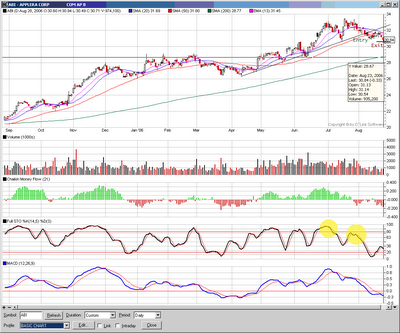 With the information available to me on 8/14 (entry, marked by the green line), you can see that the stock was in an uptrend (black line), but had a deeper pullback than previous pullbacks and had violated it's trendline. Also, you can pretty clearly see that the uptrend showed some signs of weakening before I entered the trade. The previous 2 swing highs were not as high as they should have been for a strong uptrend, and it even retested the peak. It was looking suspiciously as if the peak became resistance and that it was forming a reversal pattern as the stock crossed the 50 day moving average. The volume charateristics weren't ideal, but they weren't too bad. The CMF was negative and the Stochastics were showing some divergence (highlighted in yellow). All of what I've writen so far is me evaluating the stock today after having discussed it with Rob. Hindsight is 20/20 right? So instead, let's look back into what I wrote in my trading journal upon entry:
We looked over several of my trades to see how I was managing entry and exit. The main trade we looked at was a trade I placed on ABI. This went against me, which is why I was particularly interested in what Rob had to say about it. Let's file this one under "The Bad" (as in The Good, The Bad and The Ugly). Here's the closing chart showing where I entered and where I was stopped out for a loss:
 With the information available to me on 8/14 (entry, marked by the green line), you can see that the stock was in an uptrend (black line), but had a deeper pullback than previous pullbacks and had violated it's trendline. Also, you can pretty clearly see that the uptrend showed some signs of weakening before I entered the trade. The previous 2 swing highs were not as high as they should have been for a strong uptrend, and it even retested the peak. It was looking suspiciously as if the peak became resistance and that it was forming a reversal pattern as the stock crossed the 50 day moving average. The volume charateristics weren't ideal, but they weren't too bad. The CMF was negative and the Stochastics were showing some divergence (highlighted in yellow). All of what I've writen so far is me evaluating the stock today after having discussed it with Rob. Hindsight is 20/20 right? So instead, let's look back into what I wrote in my trading journal upon entry:
ABI pulled back a little deeper than I’d like to see and volume on the selloff was higher than I’d like to see, however the Institutional Intent shows a buying pattern during the last week. Stochastic is setting up nicely and I’m expecting a return to at least retest the previous swing high.Upon exit (8/23) I wrote the following:
That's it, that's all I wrote, and that's all I saw at the time. Of course my knowledge and skills are growing and becoming more refined, and part of that has to do with reading, studying, coach Rob's calls, but quite important to this learning process has been my self evaluation and trading journal. The mistakes are great because they provide such a learning experience. I've gone into a bit more depth in this blog posting, and this is far more reflective of how I journal today, and I'm sure how I journal will evolve over time also.Lost all of what I risked. Most likely it’s just a trade that I should not have entered. I entered when the stock dropped below the 50, near where it found support before. This was definitely a sign of a weakening trend. Additionally there was some divergence on the Stochastic. Note the previous dip and failure for a swing high in early July. Could it have gone up? Yes, of course, but I could have found a better stock to trade.The basic mistake I made on this stock is that I did not reevaluated my outlook as the stock started to show signs of weakening. I decided I wanted the stock to go up because I thought it would go up 3 days before entry and since I wasn’t filled I would just get in for a better reward:risk. I think this is known as trying to argue with the market. My mistake, market, you are correct, I will listen to what you have to say and never attempt to tell you what to do again.
Email Question: Am I Making Any Money?
On 8/18/06, Jane* wrote:
I'm pretty sure I've seen most of the negative posts or "reviews" online. The vast majority of the negative reviews are not from actual students but from people who have very limited first-hand experience with Teach Me To Trade/EduTrades. Since starting my blog, a few TMTT students have come forward to report that it is working for them and to wish me all the best. I believe these are honest, real people taking a moment to say hi and encourage me. You can see some of their comments on my blog and a few more have emailed me directly.
I've been rather diligent to seek other sources of information on trading and, if you've been reading my blog recently, you're probably aware of some of the books I've been recommending. TMTT isn't teaching something strange or magical. Similar concepts, tactics and practices can be found in many reputable books. TMTT does distill down the information to its essence and highlights and teaches the most successful of the tactics, including easy-to-follow guidelines and rules. Their marketing may be a bit over-the-top (which I personally think is what has garnered the negative "reviews"), but they teach best practices and responsibly. That's not going to stop some people from going out and donating their money to the market on haphazard trades. I have heard of some people losing a lot of money after jumping into the market -- sometimes only based on the 3-day seminar! They walk away thinking they're going to be market genius overnight! The people that have lost big-time didn't even follow the guidelines, yet they want to blame someone!
Sorry, I'm beginning to rant... how 'bout I just answer your question:
No, I have not made any money yet. The more in-depth answer is: Yes, I'm beginning to make profitable paper trades. I have not yet placed a live trade with actual money, so it's not possible for me to make money yet (it's also not possible for me to lose money yet). I will be placing live trades very soon, but am still refining my system/style and learning from some mistakes in my paper trading account. It's far cheaper to learn on a virtual account, but I'm actually a slightly positive for the last couple weeks. I've been keeping a trading journal starting from last week and I'll share some entries demonstrating the good the bad and the ugly here in my blog.
The good news is that I am getting better at entering and managing my trades. I'm also getting more consistent about my analysis. I'm more thorough and am getting a better feel for the market. I'm putting it all together and will be making trades soon, stay tuned!
*Name changed to protect the presumed innocent.
I recently attended a 3 day seminar on tmtt as the guest of someone who had paid. I thought it was quite interesting but I'm well aware of the sales tactics used and am skeptical. I saw some negatives on line about the company as well. Jane*
I'm pretty sure I've seen most of the negative posts or "reviews" online. The vast majority of the negative reviews are not from actual students but from people who have very limited first-hand experience with Teach Me To Trade/EduTrades. Since starting my blog, a few TMTT students have come forward to report that it is working for them and to wish me all the best. I believe these are honest, real people taking a moment to say hi and encourage me. You can see some of their comments on my blog and a few more have emailed me directly.
I've been rather diligent to seek other sources of information on trading and, if you've been reading my blog recently, you're probably aware of some of the books I've been recommending. TMTT isn't teaching something strange or magical. Similar concepts, tactics and practices can be found in many reputable books. TMTT does distill down the information to its essence and highlights and teaches the most successful of the tactics, including easy-to-follow guidelines and rules. Their marketing may be a bit over-the-top (which I personally think is what has garnered the negative "reviews"), but they teach best practices and responsibly. That's not going to stop some people from going out and donating their money to the market on haphazard trades. I have heard of some people losing a lot of money after jumping into the market -- sometimes only based on the 3-day seminar! They walk away thinking they're going to be market genius overnight! The people that have lost big-time didn't even follow the guidelines, yet they want to blame someone!
Sorry, I'm beginning to rant... how 'bout I just answer your question:
No, I have not made any money yet. The more in-depth answer is: Yes, I'm beginning to make profitable paper trades. I have not yet placed a live trade with actual money, so it's not possible for me to make money yet (it's also not possible for me to lose money yet). I will be placing live trades very soon, but am still refining my system/style and learning from some mistakes in my paper trading account. It's far cheaper to learn on a virtual account, but I'm actually a slightly positive for the last couple weeks. I've been keeping a trading journal starting from last week and I'll share some entries demonstrating the good the bad and the ugly here in my blog.
The good news is that I am getting better at entering and managing my trades. I'm also getting more consistent about my analysis. I'm more thorough and am getting a better feel for the market. I'm putting it all together and will be making trades soon, stay tuned!
*Name changed to protect the presumed innocent.
Tuesday, August 22, 2006
2nd Follow-Up Email ...
On 8/21/06, Name Blanked Out To Protect the Innocent ;-) wrote:
After many amateurs lost their money day-trading a few years ago the U.S. Securities & Exchange Commission decided to help protect you from yourself. In general, I'm not a fan of this sort of legislation, but I digress. They now require anyone who shows signs of pattern day trading to have a minimum of $25k in their account. You can read more on the SEC's website: The Security and Exchange Commissions Pattern Day Trading Answers. Also, you can see how Interactive Brokers handles this issue by reading this web page: Pattern Day Traders Criteria and Restrictions. Day trading is not an activity that you want to engage in unless you're well capitalized anyway, so it's probably not a bad restriction. You need over $200k in your account to take advantage of TMTT's Hedging & Institutional Tactics & Strategies (HITS) class, because in order to control the number of stocks and behave like an institution does, you'll need a lot of money.Thanks again for your reply, its much appreciated. When you say you would like to have over 25k in your account to avoid the pattern day trading restrictions, im not sure what that means if you could explain a little more. Also about the hits class requiring 200k not clear on that either. Just wondered where you got that information if your coach told you or you ask tmtt about it. Sorry if my questions are repetitive and bothering you, im just 20 years old and I am trying to soak up as much of this information as possible I know im not going to have the financial abilities as some people older than me however I believe I have time on my side also though. Also how did you purchase more days with your mentor do you call and ask for that or do they offer it to you, I haven’t heard anything about that. Also I heard that a mentor has to have a million dollars in his/her trading account before they can become a mentor just wondered if you heard that also. Thanks again for your time, Name Blanked Out To Protect the Innocent ;-)
I don't know about the > $1 million requirement for a TMTT Mentor. That's likely enough to be true, but it's not something I have any particular knowledge of. If you're eager to soak up more knowledge about trading check out the books I'm recommending in the other posts on my blog. So far I've found 3 that I think will are very helpful.
I'm 30 years old and while I wish I could have started trading sooner, I recognize that I have a far greater chance of success now. I may not have been ready for the emotional stresses and been able to contain my impulsiveness when I was younger. I don't mean to discourage you, quite the opposite, but realize that trading has inherent risk and the market is not a place to work out your personal issues. You should not be trying to prove something in the market, nor should you be rebelling against society, your father, childhood, etc... Trading requires a level-headed approach to be in it for the long haul. Putting too much of your account at risk in a given trade or trying to trade your way out of a loosing streak will likely have disastrous effects. Your goals should be to preserve your capital first, achieve steady growth second and third: make a ton of money. It should be a cold, calculated discipline. One where you are constantly reevaluating the market and how you trade to take advantage of any particular market condition.
Mark
Another New TMTT Student
On 8/20/06, Bob* wrote:
Hi Bob*,Howdy, just signed up for the classes on Saturday for TMTT. One thing I don't here about is people that have completed a couple classes complaining about how bad they were. The people that are doing most of the complaining are the ones that did not move forward. I did find a person that after a couple of years after TMTT she quit her job. Some girl in Indiana.
I actually feel pretty good about this.
Bob*
There are some people that are upset with TMTT because they want their money back. You can read more about it on ripoffreport.com and I'll be posting something about it sometime soon too. Honestly, I don't know what people expect sometimes. If you blindly listen to the sales-pitch only, without critical assessment of what's being offered and a healthy skepticism of the claims being made, you probably don't have the capacity to think independently and succeed as a trader. The marketing of TMTT is quite aggressive, and there are probably many people that buy their educational materials that really shouldn't. However, if you're serious about trading, TMTT can certainly help you. As you noted, I and many others do like the classes. At the time I bought their classes there wasn't any positive reviews of the company nor programs, just a bunch of shallow arguments about how it's a scam without any first-hand knowledge. Their courses are expensive... VERY EXPENSIVE, and they do promise a lot, but what they teach brings the most important information and tactics within reach of even the inexperienced. I see trading as the something I'm going to do for the rest of my life. 20 years from now I'll still be trading. I'm going to be smart about my money management and make every effort to trade well.
I decided to put together the blog because it's something I'd like to have seen at the time I signed up. A real, in-depth, honest assessment of what I would be getting in to. That, and the blog does help keep me honest :-P. Also, I figured that if it was a scam, I would provide a first-hand account of the scam to help prevent others from getting ripped off. If you're disciplined about learning and applying what they teach, you should do well. Definitely look for a cheap brokerage firm... Slippage and commissions can kill you as a trader. I wish you the best and will be starting a discussion board for fellow TMTT students. I already have the server and look forward to collaborating with other traders :). Best of luck to you!
Mark
On 8/22/06, Bob* wrote:
Thanks Mark. My wife and I are moving ahead we believe in what they are trying to teach people and we in it for the long haul. I will keep you up to date to our progress and knowledge and we can look at some charts together to help our progression to professional traders.
Bob*
If you check my blog, you'll see that I recycled the above statements from another email response... These books are really terrific. You can read more reviews and such on Amazon, but I can't stress enough just how useful I find these books. I haven't spent a lot of time with the Options book, but know that I'll refer to it in the future again. For the moment, I'm concentrating on mastering my technical analysis and trend spotting skills. I'll increase my leverage with Options when I'm more consistent with stocks.
I look forward to collaborating with you and others about stocks and options and will get a discussion board up very soon to facilitate the information exchange.
Mark
*Name has been changed to protect the presumed innocent.
Soon-To-Be TMTT Student Email
On 8/22/06, Jim* wrote:
You're welcome... the blog's a lot of work, but I know I'm helping others make more informed decisions. I know I'd like to have seen something like my blog when I was signing up for courses. If you're really interested in trading for a living I'm finding The Complete Trading for a Living by Dr. Alexander Elder to be very useful and is probably a good place to start, even before any TMTT classes (and it's only $40, including the study guide in a leather bound edition, I bought the study guide separately and spent more!). Add what's commonly known as the Technical Analysis and Options "Bibles": Technical Analysis of the Financial Markets by John J. Murphy and Options as a Strategic Investment by Lawrence G. McMillan, and you'll have a head start on trading and be even more prepared for what TMTT can teach you.
Best of Luck and Diligence!
Mark
*Name changed to protect the presumed innocent.
Mark,Boy am I glad I stumbled across your post.I went to the TMTT 3 day seminar, but found myselfvery skeptical about dropping the kind of money theywanted (especially since I've recently beeen victim of a corporate downsize), even though I found myself interestedin the course. (maybe the Russ Whitney connection wasjust too slimy for me).Anyway, I was looking for anyone who had experiencewith TMTT, and thank God, you popped up.I wish you nothing but the best of luck (probably for some selfish reasons - so I'll feel safe buying the course the next time they're in town). Keep up the great work, and thanks for the honesty.
Jim*
You're welcome... the blog's a lot of work, but I know I'm helping others make more informed decisions. I know I'd like to have seen something like my blog when I was signing up for courses. If you're really interested in trading for a living I'm finding The Complete Trading for a Living by Dr. Alexander Elder to be very useful and is probably a good place to start, even before any TMTT classes (and it's only $40, including the study guide in a leather bound edition, I bought the study guide separately and spent more!). Add what's commonly known as the Technical Analysis and Options "Bibles": Technical Analysis of the Financial Markets by John J. Murphy and Options as a Strategic Investment by Lawrence G. McMillan, and you'll have a head start on trading and be even more prepared for what TMTT can teach you.
Best of Luck and Diligence!
Mark
*Name changed to protect the presumed innocent.
Monday, August 21, 2006
Study of Market Charts
As part of my technical analysis for trading I take some time, at least once a week, to study the board market indexes. It's a known phenominon that an individual stock's direction is heavily influenced by the general market direction. Cliches like "a rising tide lifts all boats" are quite applicable. I've drawn some trend lines and key support and resistance in the following charts to help guide my eyes. This technical analysis is based on what I've learned from Teach Me To Trade as well as Technical Analysis of the Financial Markets by John J. Murphy. I'll attempt to identify the source as I explain what I've drawn in, etc...
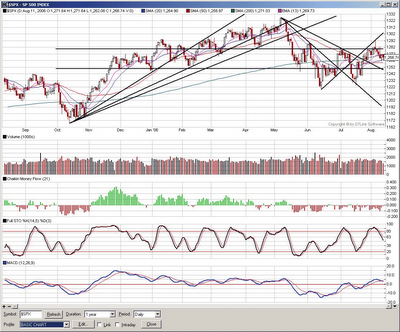 On the right is my analysis of the S&P 500 10 days ago (August 11, 2006). I drew in the 3 ascending trendlines following the Fan pattern that Murphy describes in his book. Another idea that Murphy brings to light is 2/3 retrace. Simply stated: we can expect a 1/3 retrace from the low to the high, however if we fall through that we may find support at 1/2 way down from the peak, and after that 2/3 way down. What you'll notice on the S&P 500 over the last year matches this pattern pretty well. Notice that there's basically 150 points between the low in October to the high in early May. Interestingly enough, there's a bump at the halfway point on the retrace in mid May. After the market crashed through that level of support it retraced down almost exactly 100 points to find support 2/3 down from the peak to early-to-mid June. Take a really good look at the trendlines I've drawn in. They are initially drawn along the line of support on uptrends and resistance on downtrends, but notice how once the trendline (support) was violated it became resistance. This is especially true of the first trendline for both bottom (uptrend support) & top (downtrend resistance).
Because of this purely technical market analysis, two weeks ago I was expecting the bear market to be weakening and that we may soon see a bull market. At the time of the analysis (August 11) it was not exactly a certainty, and I honestly expected some consolidation before we actually see a true uptrend. However, it has lead me to favor my bulls watchlist for long positions that currently have a good setups, rather than continuing to be weighted towards the bearish side.
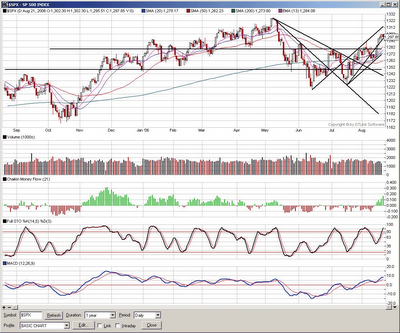 Here's an updated chart for the S&P 500 as of today. I've drawn in all the same forward-looking lines as was in the previous version, adding a couple new trendlines showing current market trend. These are not very well established, and because August's history as being a bad month (August Angst) a great number of people expect it to be the worst month of the year. The S&P 500 has managed to show some signs of predictability, but from a purely technical analysis, it's a time to be cautiously optimistic IMHO.
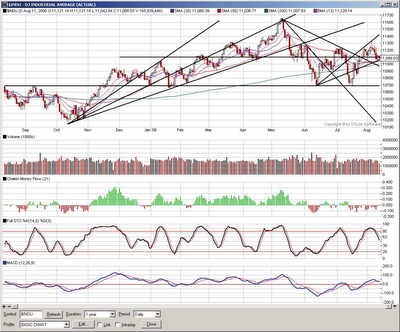
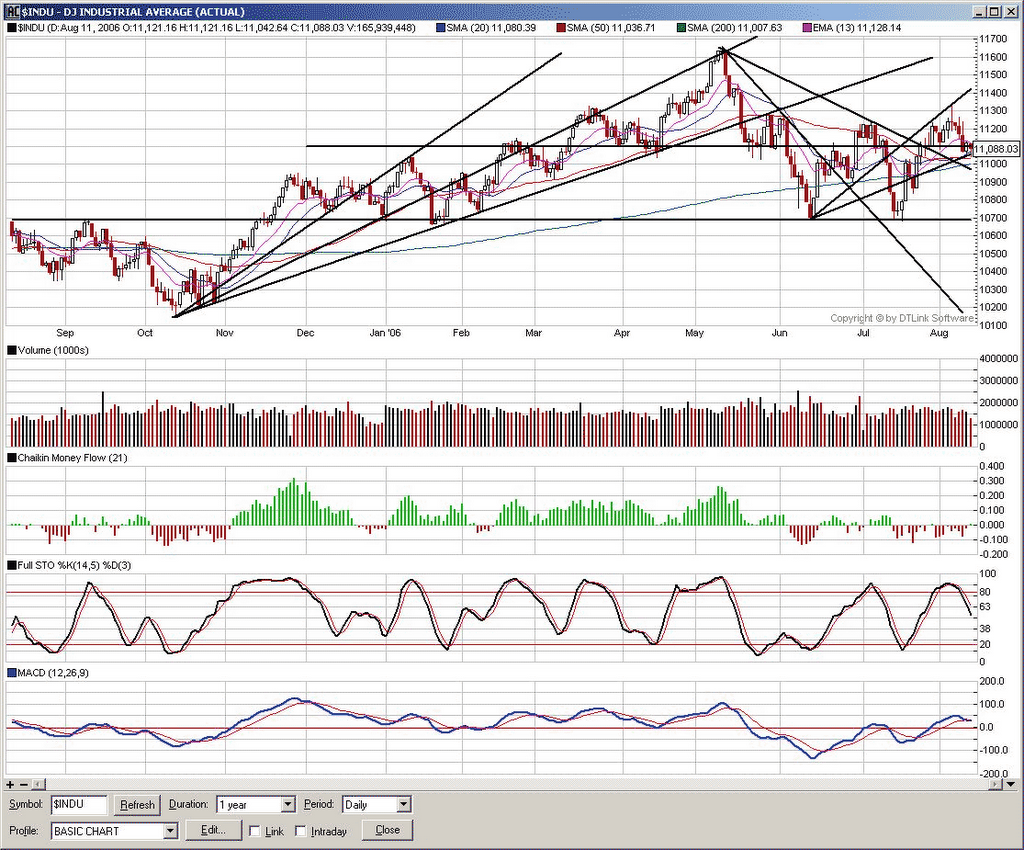
Below is a similar study of the Dow Jones Industrial Average. Notice how many of the same phenomina appear on the DJI as the S&P.
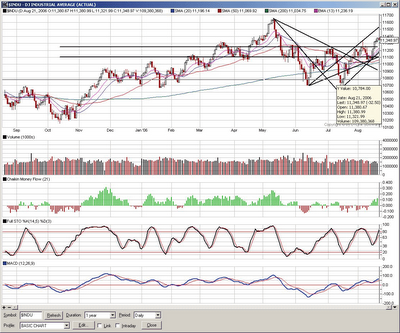
Please consider your source carefully when taking anyone's opinion about the outlook for the markets and/or stocks; after all, if you're taking my interpretation, allow me to remind you that I haven't even placed a trade with real money yet! I just wanted to let you see an example of how I'm looking at the market to help determine my positions. All of the above is only my interpretation & opinion, so be especially skeptical! I hope that in the future I can look back at this post and either 1) be proud of my decent interpretation or 2) laugh about how I could have such an outlook based on the charts because my technical analysis skills are so much better.
This post resembles a trading journal entry in many ways and it is part of my journaling activities. I'll give an example of my trading journal soon. As in music, the best person to learn from is yourself; it does require that you keep a certain detached, honest perspective in order for you to learn from your strengths & weaknesses. In music, the sound you produce is your ultimate goal and a mic is brutally honest and allows you a external perspective of how effective your efforts are. Listening to the playback with an impartial ear is one of the most effective self-teaching tools available. A trading journal is a way of capturing your thoughts, justifications, emotions, etc... at open and close of a trade. It gives you insight into your own trading strengths and weaknesses and thus is a learning tool that's custom tailored to you.
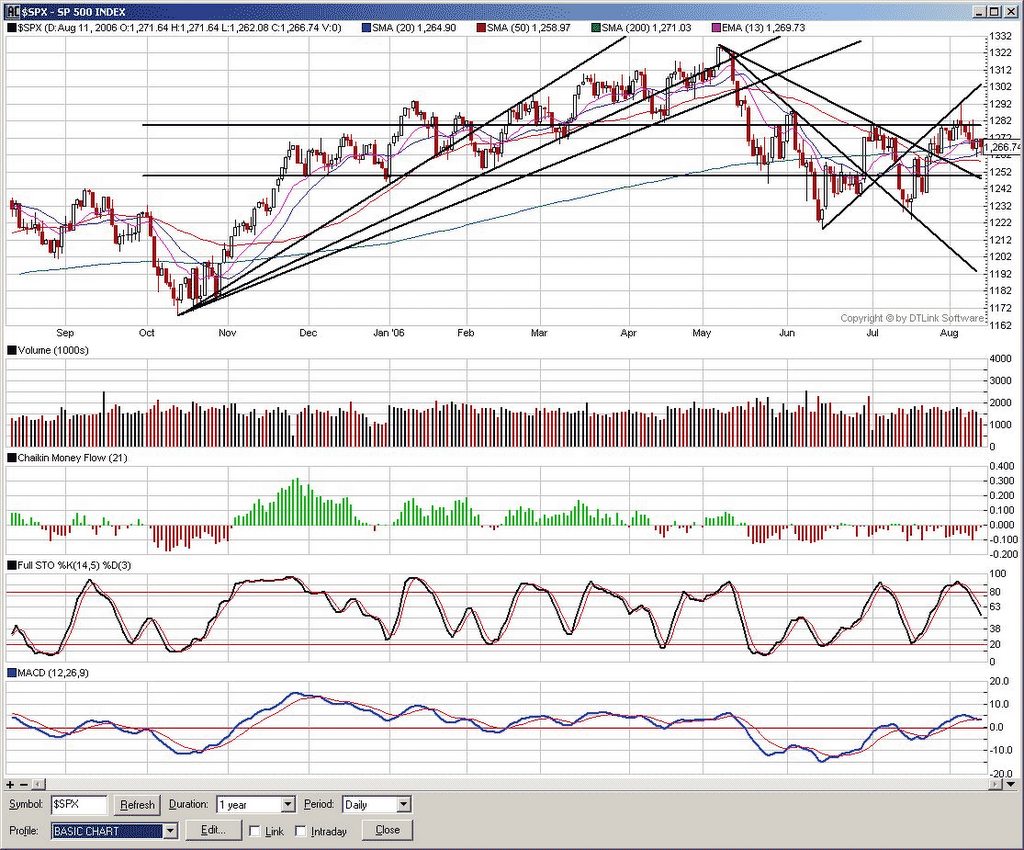 On the right is my analysis of the S&P 500 10 days ago (August 11, 2006). I drew in the 3 ascending trendlines following the Fan pattern that Murphy describes in his book. Another idea that Murphy brings to light is 2/3 retrace. Simply stated: we can expect a 1/3 retrace from the low to the high, however if we fall through that we may find support at 1/2 way down from the peak, and after that 2/3 way down. What you'll notice on the S&P 500 over the last year matches this pattern pretty well. Notice that there's basically 150 points between the low in October to the high in early May. Interestingly enough, there's a bump at the halfway point on the retrace in mid May. After the market crashed through that level of support it retraced down almost exactly 100 points to find support 2/3 down from the peak to early-to-mid June. Take a really good look at the trendlines I've drawn in. They are initially drawn along the line of support on uptrends and resistance on downtrends, but notice how once the trendline (support) was violated it became resistance. This is especially true of the first trendline for both bottom (uptrend support) & top (downtrend resistance).
Because of this purely technical market analysis, two weeks ago I was expecting the bear market to be weakening and that we may soon see a bull market. At the time of the analysis (August 11) it was not exactly a certainty, and I honestly expected some consolidation before we actually see a true uptrend. However, it has lead me to favor my bulls watchlist for long positions that currently have a good setups, rather than continuing to be weighted towards the bearish side.
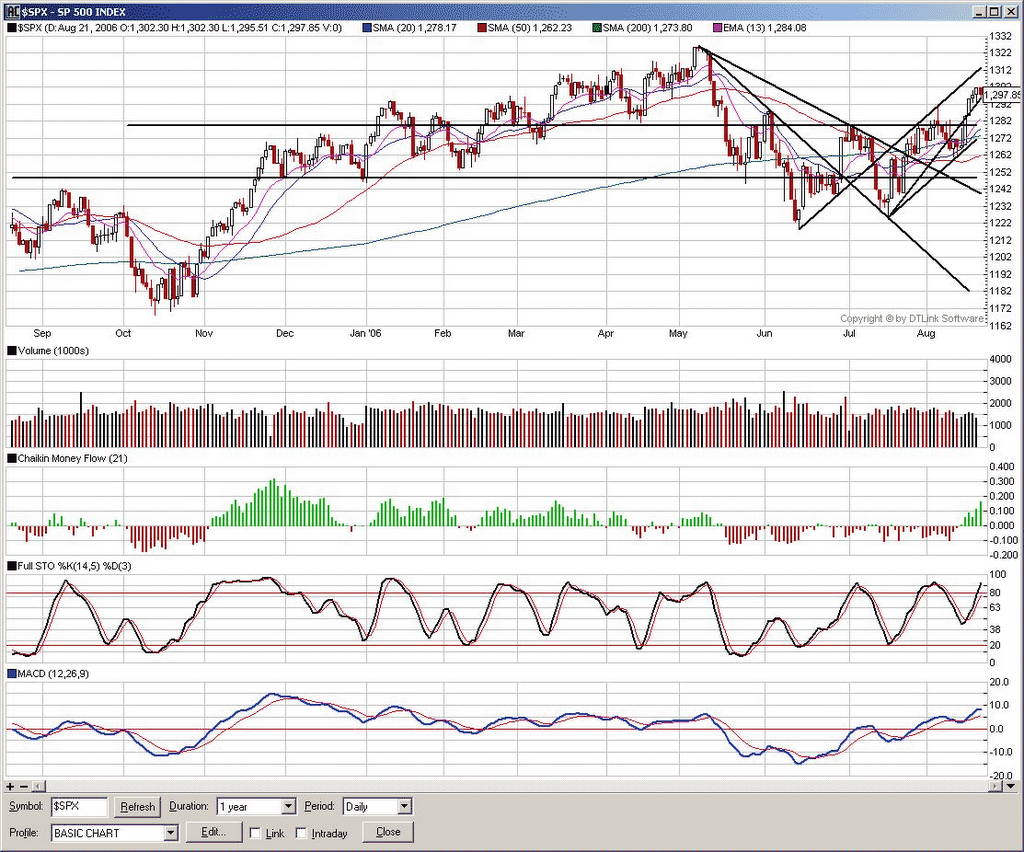 Here's an updated chart for the S&P 500 as of today. I've drawn in all the same forward-looking lines as was in the previous version, adding a couple new trendlines showing current market trend. These are not very well established, and because August's history as being a bad month (August Angst) a great number of people expect it to be the worst month of the year. The S&P 500 has managed to show some signs of predictability, but from a purely technical analysis, it's a time to be cautiously optimistic IMHO.
Below is a similar study of the Dow Jones Industrial Average. Notice how many of the same phenomina appear on the DJI as the S&P.
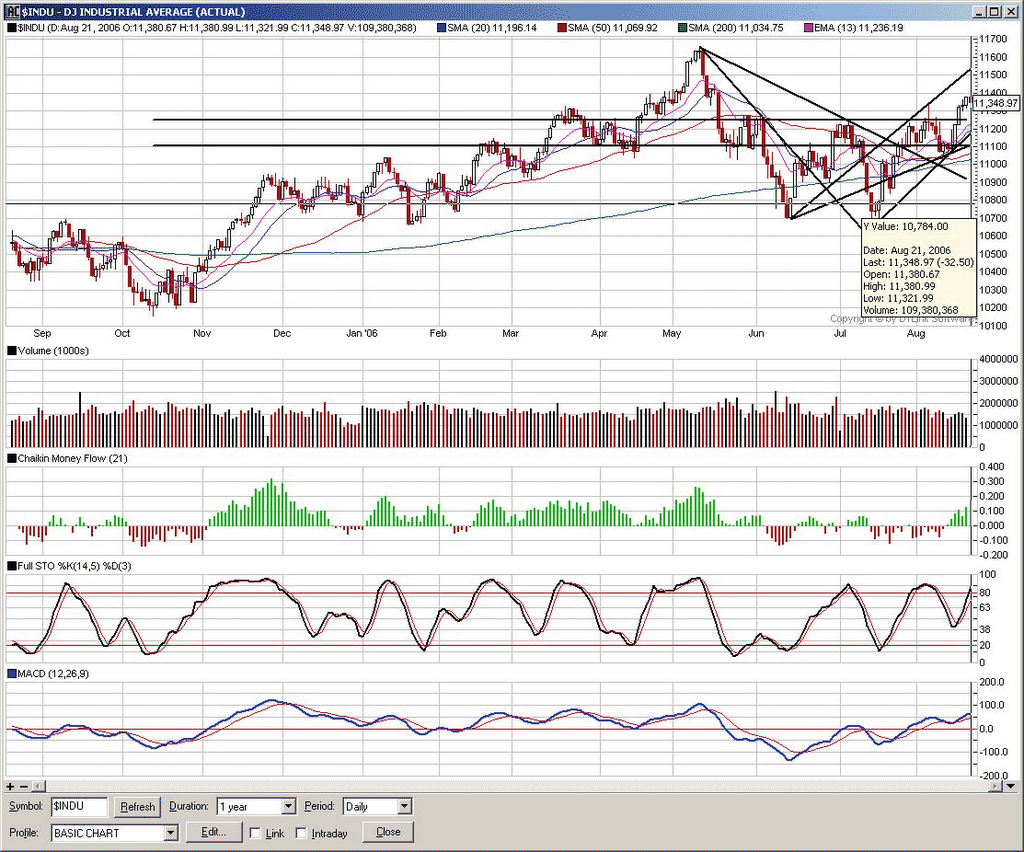
Please consider your source carefully when taking anyone's opinion about the outlook for the markets and/or stocks; after all, if you're taking my interpretation, allow me to remind you that I haven't even placed a trade with real money yet! I just wanted to let you see an example of how I'm looking at the market to help determine my positions. All of the above is only my interpretation & opinion, so be especially skeptical! I hope that in the future I can look back at this post and either 1) be proud of my decent interpretation or 2) laugh about how I could have such an outlook based on the charts because my technical analysis skills are so much better.
This post resembles a trading journal entry in many ways and it is part of my journaling activities. I'll give an example of my trading journal soon. As in music, the best person to learn from is yourself; it does require that you keep a certain detached, honest perspective in order for you to learn from your strengths & weaknesses. In music, the sound you produce is your ultimate goal and a mic is brutally honest and allows you a external perspective of how effective your efforts are. Listening to the playback with an impartial ear is one of the most effective self-teaching tools available. A trading journal is a way of capturing your thoughts, justifications, emotions, etc... at open and close of a trade. It gives you insight into your own trading strengths and weaknesses and thus is a learning tool that's custom tailored to you.
Follow-Up Email About Market Reversals
Here's the follow-up to the previous email question I received about coaching along with my response...
I'm highly considering going to the trading room class, but I'd like to have more money in my account when I get there. I'd like to have over $25k in order to avoid the pattern day trading restrictions. I also plan to attend the Advanced Trading P.I.T. The HITS class really has my attention, but I think I'd like to take their Advanced Technical Analysis class first. Well, that and the HITS class requires > $200k in your account to be able to employ the Institutional tactics. My plan isn't set in stone quite yet, and attending a class that isn't offered online is a bit too much of a hardship for me at the moment. I still need my job and the money that pays the bills, and taking off for a few days isn't an option for the next couple months.
There are signs about market reversals. They seem to be slightly clearer on the broad market charts and I'll be posting some of the chart analysis work on the markets to my blog very soon. Basically when you start to see the swing lows (or swing highs) weakening, it's time to reevaluate your market outlook. During such transitional times you can look through your watchlist for the next direction and see if there are any good setups. During such transitional times, you probably need to keep your stop-loss a little looser and accept that additional risk. Certainly the trade can still go against you and a volatile, switching market isn't the easiest to navigate, but you have the potential for some nice reward. Simply being a sheep and only following the trend isn't necessarily the best way either although it's "safer" if you really wait for the stock to come to you and pay attention to reversal signs (weakening swing highs/lows, exhaustion gaps, extended range candles, etc...). Bottom line is that there are signs the market is turning, but it takes some practice to spot them. Even when you spot them it just may mean that you should NOT trade until you have confirmation of the new trend. It's a highly personal decision and interpretation, but remember one of the most powerful abilities you have as an individual trader is that you do not have to trade. You can keep your money out until you see a trade that you just can't pass up.
I'm a detail oriented guy (just in case you couldn't tell from my blog) and I've taken to the following books for further information/motivation behind what TMTT teaches: Technical Analysis of the Financial Markets: A Comprehensive Guide to Trading Methods and Applications by John J. Murphy and Trading for a Living: Psychology, Trading Tactics, Money Management by Dr. Alexander Elder. Basically I'm looking to these books for a bit of the why behind the what. TMTT does a nice job of compressing the information down to get you successful asap, but I like to know the motivation behind the rules. I'll post some thoughts on each book soon as I continue to read.
On 8/20/06, Name Blanked Out To Protect the Innocent ;-) wrote:
Thanks for your time to email me back. Are you going to the trading room class. This class really interests me because you can see them trading and do what they are doing. I think I would learn a lot at that one because I'm better at seeing it and doing it, also they say they make a lot of money at that class which would be nice to see some profit. Also the market looks like it just went back into an uptrend and is bullish rather than bearish and trades are harder to find with the switch taking place wondered if you had the same opinion.
I'm highly considering going to the trading room class, but I'd like to have more money in my account when I get there. I'd like to have over $25k in order to avoid the pattern day trading restrictions. I also plan to attend the Advanced Trading P.I.T. The HITS class really has my attention, but I think I'd like to take their Advanced Technical Analysis class first. Well, that and the HITS class requires > $200k in your account to be able to employ the Institutional tactics. My plan isn't set in stone quite yet, and attending a class that isn't offered online is a bit too much of a hardship for me at the moment. I still need my job and the money that pays the bills, and taking off for a few days isn't an option for the next couple months.
There are signs about market reversals. They seem to be slightly clearer on the broad market charts and I'll be posting some of the chart analysis work on the markets to my blog very soon. Basically when you start to see the swing lows (or swing highs) weakening, it's time to reevaluate your market outlook. During such transitional times you can look through your watchlist for the next direction and see if there are any good setups. During such transitional times, you probably need to keep your stop-loss a little looser and accept that additional risk. Certainly the trade can still go against you and a volatile, switching market isn't the easiest to navigate, but you have the potential for some nice reward. Simply being a sheep and only following the trend isn't necessarily the best way either although it's "safer" if you really wait for the stock to come to you and pay attention to reversal signs (weakening swing highs/lows, exhaustion gaps, extended range candles, etc...). Bottom line is that there are signs the market is turning, but it takes some practice to spot them. Even when you spot them it just may mean that you should NOT trade until you have confirmation of the new trend. It's a highly personal decision and interpretation, but remember one of the most powerful abilities you have as an individual trader is that you do not have to trade. You can keep your money out until you see a trade that you just can't pass up.
I'm a detail oriented guy (just in case you couldn't tell from my blog) and I've taken to the following books for further information/motivation behind what TMTT teaches: Technical Analysis of the Financial Markets: A Comprehensive Guide to Trading Methods and Applications by John J. Murphy and Trading for a Living: Psychology, Trading Tactics, Money Management by Dr. Alexander Elder. Basically I'm looking to these books for a bit of the why behind the what. TMTT does a nice job of compressing the information down to get you successful asap, but I like to know the motivation behind the rules. I'll post some thoughts on each book soon as I continue to read.
Friday, August 18, 2006
Coaching Question From Fellow TMTT Student
I've received a few questions most every week and have chosen to privately respond directly to the sender. I'm rethinking that and will post select emails with my answer at my discretion. I'd like to take this moment to apologize for my recent delays in posts. I performed in a Wedding last Saturday and participated in a Triathlon on Sunday. Between all those activities I haven't had a lot of time to write up posts for my blog, but you'll see more regular posts again. I've been using my available time to evaluate stocks and put in paper trades. More on all that in a separate post, for now... On with the question:
I've been paper trading and am beginning to see some consistency with my choices. It takes some practice. If you read my post-mortem on my second update to paper trading, you'll understand how I'm learning from my past mistakes. The way I see it is that this is the best way for me to get the most of my experience. It's not simply enough to do this half-heartedly. On every trade it's important to evaluate what went wrong and what went right. A trading journal is an invaluable learning tool. I don't know if you've started a trading journal but I'll post about what I'm tracking in my trading journal soon. I'm just a burgeoning trader and am cutting my teeth with paper trades, but let me tell you, I'm managing them and thinking of the trades exactly as if they were real money.
To answer your questions about what package etc... My father and I purchased the Platinum package: 4 advanced training courses and a couple days with a mentor. Eventually we were sold an add-on package of coaching, an additional class, and another couple days with a mentor. I jumped on this opportunity, because the sales pitch was just that good. In retrospect (and gently stated earlier in my blog), although I'm very happy with the coaching I'm receiving, I'd rather have only paid $3,500 for the coaching alone, as I feel I already had purchased enough classes and time with my mentor to become a professional trader, and could eventually add the classes on with money that I make in the markets. However, I will be taking advantage of these additional courses and look forward to taking advantage of all that I've paid for.
I really cannot state strongly enough how happy I am with the coaching. It's a weekly call that helps keep me in the rhythm of trading and also gives me an experienced trader to ask questions of. It's not just a rehashing of the Master Trader class, at least not with my coach. Having taken Master Trader has given me the foundation to get the most from my coach and he's helped me tremendously towards putting the theory and lessons learned in Master Trader into practice. It's taken the "what do I do now?" question out of the equation with a simple set of building blocks that add to my arsenal of tools to help me choose the best trades. Given the choice to do this all over again, I'd definitely choose the coaching program.
Of course this is just my opinion. Everybody has their own pace and style and the person you'll learn the most from is yourself. You may not need the coaching, especially if you manage to journal your trades at open and close. It may not be intuitive, but you can have the majority of trades go against you and you can still make money. I'm just starting to see a net positive from my positions. It is hard to take to watch trades go against you, but that's just part of the game. Having a system helps remove the emotional component which can otherwise scare you out of the market. Refining that system to meet current market conditions seems to be the way to make it as a professional trader. Consistency and discipline in your day-to-day trading routine will eventually make you the trader that you want to be.
On 8/17/06, Name Blanked Out To Protect the Innocent ;-) wrote:
I saw your website and it is interesting. I am in the classes also just wondered how you like it and if you have had any success yet. I have only gone to the master trader class so far and am going to attend the covered calls shortly. Just wondered when you are going to get your mentor and what package you chose. The trading room class sounds interesting so you can actually make some money. I got a call to do the coaching also however I didn't like how they were pushing me in to purchasing it, my teacher for the master trader class said it would just be a rehash of the class, I was wanting your opinion to see if you think it has helped you. I am really excited about becoming a trader but getting started is frustrating especially when trades go against you. I have been paper trading for a while and got some consistency so I did a couple real trades and they got me down because they went the wrong way. Just wanted your opinion on the classes and school.
I've been paper trading and am beginning to see some consistency with my choices. It takes some practice. If you read my post-mortem on my second update to paper trading, you'll understand how I'm learning from my past mistakes. The way I see it is that this is the best way for me to get the most of my experience. It's not simply enough to do this half-heartedly. On every trade it's important to evaluate what went wrong and what went right. A trading journal is an invaluable learning tool. I don't know if you've started a trading journal but I'll post about what I'm tracking in my trading journal soon. I'm just a burgeoning trader and am cutting my teeth with paper trades, but let me tell you, I'm managing them and thinking of the trades exactly as if they were real money.
To answer your questions about what package etc... My father and I purchased the Platinum package: 4 advanced training courses and a couple days with a mentor. Eventually we were sold an add-on package of coaching, an additional class, and another couple days with a mentor. I jumped on this opportunity, because the sales pitch was just that good. In retrospect (and gently stated earlier in my blog), although I'm very happy with the coaching I'm receiving, I'd rather have only paid $3,500 for the coaching alone, as I feel I already had purchased enough classes and time with my mentor to become a professional trader, and could eventually add the classes on with money that I make in the markets. However, I will be taking advantage of these additional courses and look forward to taking advantage of all that I've paid for.
I really cannot state strongly enough how happy I am with the coaching. It's a weekly call that helps keep me in the rhythm of trading and also gives me an experienced trader to ask questions of. It's not just a rehashing of the Master Trader class, at least not with my coach. Having taken Master Trader has given me the foundation to get the most from my coach and he's helped me tremendously towards putting the theory and lessons learned in Master Trader into practice. It's taken the "what do I do now?" question out of the equation with a simple set of building blocks that add to my arsenal of tools to help me choose the best trades. Given the choice to do this all over again, I'd definitely choose the coaching program.
Of course this is just my opinion. Everybody has their own pace and style and the person you'll learn the most from is yourself. You may not need the coaching, especially if you manage to journal your trades at open and close. It may not be intuitive, but you can have the majority of trades go against you and you can still make money. I'm just starting to see a net positive from my positions. It is hard to take to watch trades go against you, but that's just part of the game. Having a system helps remove the emotional component which can otherwise scare you out of the market. Refining that system to meet current market conditions seems to be the way to make it as a professional trader. Consistency and discipline in your day-to-day trading routine will eventually make you the trader that you want to be.
Wednesday, August 16, 2006
Coaching Call Week 8
Today coach Rob and I reviewed Chapter 6: Intermarket Analysis. Although we did go through the chapter, the majority of our time was spent in a hands-on fashion, evaluating a couple of the stocks in my hotwatch folder. There are a number of free tools out there to aid evaluating a stock relative to it's sector, industry and competitors.
To figure out a stock's relative strength to a given sector we used SmartMoney.com's Sector Tracker . Sometimes it's a little tricky to discover which sector a stock belongs to because there isn't a clear standard. We ran into this difficulty with ORB however, by looking at ORB's competitors, the we figured that it's part of Aerospace & Defense. It's useful to know which sector a stock is part of not only to help evaluate its strength relative to the sector, but the sector's strength relative to other sectors and the market as a whole. It's yet another way to filter for best-of-breed stocks. Another benefit of drilling down into the sector is that you will likely come across another stock that you'd like to add to your hotwatch and/or trade instead of your original stock. After all, if the sector is performing well relative to the market, you may as well take a look at other stocks in that sector as it's not uncommon for the majority of stocks in a given sector to perform similarly.
After identifying the sector we used Yahoo! Finance to compare our stock (ORB) to the best of the sector. SmartMoney.com's Sector Tracker allows us to drill down into the sector to see what stocks comprise the sector. We chose the top 3 performers and entered them on Yahoo! Finance's charting "vs" feature. Yahoo! Finance allows you to enter a number of stocks to compare to the current stock (enter multiple symbols by separating them with a comma). This gives you a pretty good picture of how your stock's relative strength to its competitors.
Another handy feature that SmartMoney.com provides is insider buying and selling. It seems to make sense that if the employees of a company are actually buying shares of their own company, then the people on the inside think the value of the stock value will increase. On the surface it seems like a good indicator, however most of the time buying won't show because the stocks are given to the employees as incentive or reward, but they don't show up as a purchase. However, when an employee sells, it's most certainly going to show on the insider tracking. Consequently, you're more likely to see sell orders than buy. Once more, this information requires some interpretation.
Combine all of the above with all of the technical analysis tools, volume, indicators and last week's lesson on institutional intent and you have quite a bit more evidence to support your position & outlook for a given stock. There are no guarantees, but filling in the picture with more information can either give us a higher probability or it can be enough for us to decide to simply walk away from a trade.
No doubt that it takes some time and energy to do all this research, but it is your money and if you aren't happy with part of the picture, why risk it? There are so many stocks to choose from, it seems like good practice to choose the best-of-the-best and to not bother with the rest. Don't you think it's worth that bit of extra effort on each trade?
To figure out a stock's relative strength to a given sector we used SmartMoney.com's Sector Tracker . Sometimes it's a little tricky to discover which sector a stock belongs to because there isn't a clear standard. We ran into this difficulty with ORB however, by looking at ORB's competitors, the we figured that it's part of Aerospace & Defense. It's useful to know which sector a stock is part of not only to help evaluate its strength relative to the sector, but the sector's strength relative to other sectors and the market as a whole. It's yet another way to filter for best-of-breed stocks. Another benefit of drilling down into the sector is that you will likely come across another stock that you'd like to add to your hotwatch and/or trade instead of your original stock. After all, if the sector is performing well relative to the market, you may as well take a look at other stocks in that sector as it's not uncommon for the majority of stocks in a given sector to perform similarly.
After identifying the sector we used Yahoo! Finance to compare our stock (ORB) to the best of the sector. SmartMoney.com's Sector Tracker allows us to drill down into the sector to see what stocks comprise the sector. We chose the top 3 performers and entered them on Yahoo! Finance's charting "vs" feature. Yahoo! Finance allows you to enter a number of stocks to compare to the current stock (enter multiple symbols by separating them with a comma). This gives you a pretty good picture of how your stock's relative strength to its competitors.
Another handy feature that SmartMoney.com provides is insider buying and selling. It seems to make sense that if the employees of a company are actually buying shares of their own company, then the people on the inside think the value of the stock value will increase. On the surface it seems like a good indicator, however most of the time buying won't show because the stocks are given to the employees as incentive or reward, but they don't show up as a purchase. However, when an employee sells, it's most certainly going to show on the insider tracking. Consequently, you're more likely to see sell orders than buy. Once more, this information requires some interpretation.
Combine all of the above with all of the technical analysis tools, volume, indicators and last week's lesson on institutional intent and you have quite a bit more evidence to support your position & outlook for a given stock. There are no guarantees, but filling in the picture with more information can either give us a higher probability or it can be enough for us to decide to simply walk away from a trade.
No doubt that it takes some time and energy to do all this research, but it is your money and if you aren't happy with part of the picture, why risk it? There are so many stocks to choose from, it seems like good practice to choose the best-of-the-best and to not bother with the rest. Don't you think it's worth that bit of extra effort on each trade?
Subscribe to:
Posts (Atom)